
Selwyn District Council Catchment Management Plans
A six-year programme transforming how seven lowland drainage catchments discharging to Te Waihora/Lake Ellesmere are valued and managed, one Catchment Management Plan (CMP) at a time.
2021–2026
context
Te Waihora/Lake Ellesmere is Aotearoa New Zealand’s largest coastal hāpua/waituna – 198 km2 of ecological, cultural, and economic significance, and one of the most degraded coastal lakes in the country. Seven rated land drainage schemes in the Selwyn District discharge into it or its tributary catchments. These lowland drainage networks were originally engineered for the key purpose of moving water off productive farmland, but they are also waterway systems with ecological and cultural values in their own right.
In 2021, the Department of Conservation (DOC)–Fonterra Living Water partnership commissioned EOS Ecology, Aqualinc Research and Cawthron Institute to develop a new kind of catchment plan for the Ararira/LII – one that would fundamentally change the way waterways were valued and managed by incorporating ecological and cultural principles alongside existing drainage values. The CMP and Implementation Guide (IG) was developed in collaboration with Te Taumutu Rūnanga, LII Drainage Committee, Selwyn District Council (SDC), DOC, Fonterra, Environment Canterbury, and Learning for Sustainability, and then gifted to SDC upon its completion. This was the pilot that proved the model – SDC has since commissioned EOS Ecology and Aqualinc Research to apply the same approach across their other six rated catchments in the district.

challenge
- Multiple competing values – flood protection, water quality, mahinga kai, biodiversity, cultural heritage, and community recreation – all have legitimate claims on the same systems. The plans had to hold that range of interests simultaneously, not prioritise one at the expense of the others.
- Multiple bespoke challenges in each catchment, along with water quality challenges influenced by activities outside the surface water catchment, and a system sensitive to any change in downstream water level.
- Existing mapped waterway networks reflect only a small portion of the waterways and channels that exist in each catchment. Before we could hope to provide solutions across the catchment, we first needed to develop an accurate waterways and channels layer.
- Drainage networks are fragmented across hundreds of private landholdings, council-managed rated networks, and unrated channels. A catchment-scale ecologically-based management approach had to connect all the way down to site-scale decisions for individual landowners.
- Te Taumutu Rūnanga’s relationship with Te Waihora and its tributary catchments spans more than the lifetime of the rated network. Any plan that didn’t genuinely integrate that history, knowledge, and vision would lack both legitimacy and the depth of understanding needed to guide real change.
- Translating complex, multidisciplinary science into plans that landowners, council staff, drainage committee members, and elected representatives could actually understand and act on demanded as much effective communication design thinking as it did ecological expertise.
our role
EOS Ecology has been the lead ecological author across the entire CMP programme, from the pilot Ararira/LII CMP through to a total of seven catchments over six years. We are responsible for the ecological assessments, establishing the past and present state of each catchment, implementing the spatial analysis and mapping of the waterway network, the co-design of catchment-scale and reach-scale solutions, and the science interpretation and graphic design that makes these plans usable by the communities they are written for. We work as one team with Aqualinc Research, who provide the groundwater hydrology expertise and manage the overall programme. The programme’s endurance reflects an adaptive, co-creation approach with each rated catchment’s working party, and an ongoing commitment by SDC to this model of values-based catchment planning.


how we approached it
- Led the ecological assessment across all seven catchments, implementing surveys to fill data gaps for freshwater ecology (macroinvertebrates, fish, and eDNA). Synthesised all data (new and existing) to provide overviews of past and present state for a range of landscape, ecology, and water quality values, as well as integrating cultural values through engagement with Te Taumutu Rūnanga.
- Built a new spatial framework using LiDAR-generated Digital Elevation Models to create accurate waterways layers for each catchment, ground-truthed through extensive field surveys assessing flow permanence, channel condition, and ecology. This replaced existing GIS layers that significantly underrepresented the actual extent and connectivity of the drainage networks.
- Developed the co-design process around working parties for each catchment – not as sign-off mechanisms, but as the genuine source of each plan’s vision. Built around four value baskets – Mauri & Ecosystem Health, Community & Livelihoods, Land Drainage, and Cultural Values – the process brought together tangata whenua, drainage committee ratepayers, conservation managers, regulators, and local government.
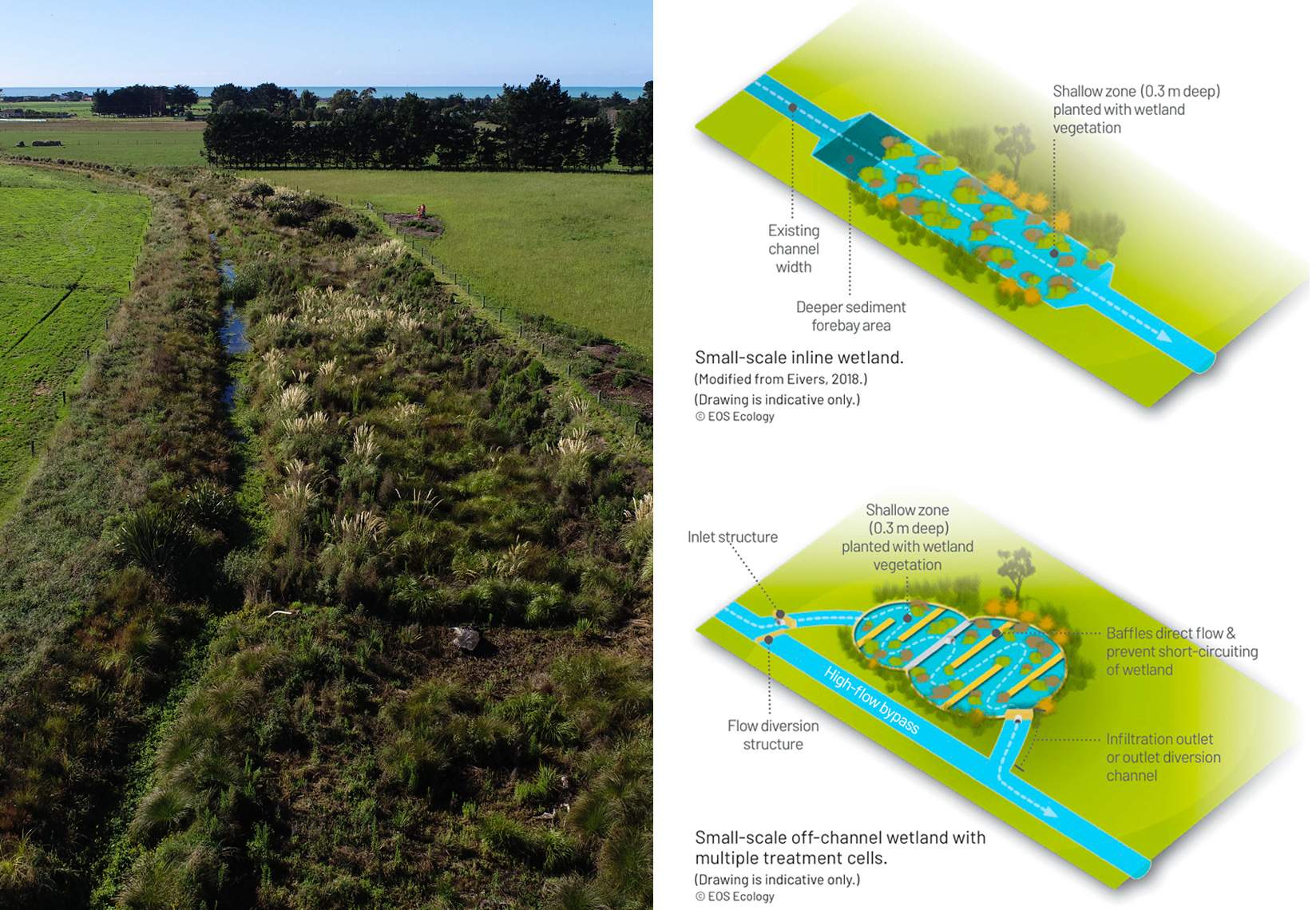
- Designed a linked framework of CMP, spatial Master Plan, and Implementation Guide for each catchment, with a suite of catchment-scale approaches and a toolbox of reach-scale interventions customised for different waterway types – from ephemeral channels to perennial streams. The phased delivery allowed each successive CMP to build on lessons from the last while remaining specific to its catchment.
- Led science communication and graphic design across the programme, translating complex multidisciplinary science into highly visual, accessible documents designed for public dissemination – from detailed technical plans through to summary documents, infographics, and a ‘blueprint for change’ diagram that has become a reference for the programme’s approach.

outcome
Completed in 2023, the Ararira/LII CMP and Implementation Guide proved the model – a co-designed, science-based roadmap for transforming a managed drainage network into a biodiverse, culturally meaningful waterway system. It was presented to SDC Councillors and met with strong support, and its success led directly to SDC commissioning CMPs for the remaining six catchments.
The Osbornes Drain CMP was completed in March 2026, giving the catchment something it had never had: a shared, evidence-based, community-owned plan, built around genuine relationships that predate the plan by two decades. The Wairiri Valley CMP and the Combined Te Waihora CMP (covering Greenpark, Ellesmere, Leeston, and Taumutu), have since been completed.
Delivering the CMPs in a phased approach has allowed us to build efficiencies across the programme – each successive CMP benefits from refined methodology, shared implementation guidance, and a visual language that is now recognisable as part of a wider whole. The CMPs have positioned SDC to make informed, strategic decisions and respond effectively to future needs, including the resource consents required for ongoing drainage network operation and improvement across the rated catchments.
wider impact
- Demonstrated that a co-design model built around genuine, longstanding relationships can produce plans that all parties stand behind, not just sign off on. The working party model has been sustained across multiple catchments and years.
- The Ararira/LII CMP has been cited as a reference example within the Living Water programme, and the ‘blueprint for change’ approach is directly applicable to other drainage districts across Aotearoa New Zealand – a clear, replicable process for values-based catchment planning that other regions can emulate.
- The programme integrates threatened species management into catchment-scale planning, including specific interventions for species such as kōwaro/Canterbury mudfish and īnanga – demonstrating that drainage network management and biodiversity protection are not competing objectives when the planning framework is right.